
Where product ideas actually come from
E.M.U.C — employees, metrics, users and clients. Four doors that each tell you something true, each lie to you in a different direction, and only describe a real problem when you read all four at once.
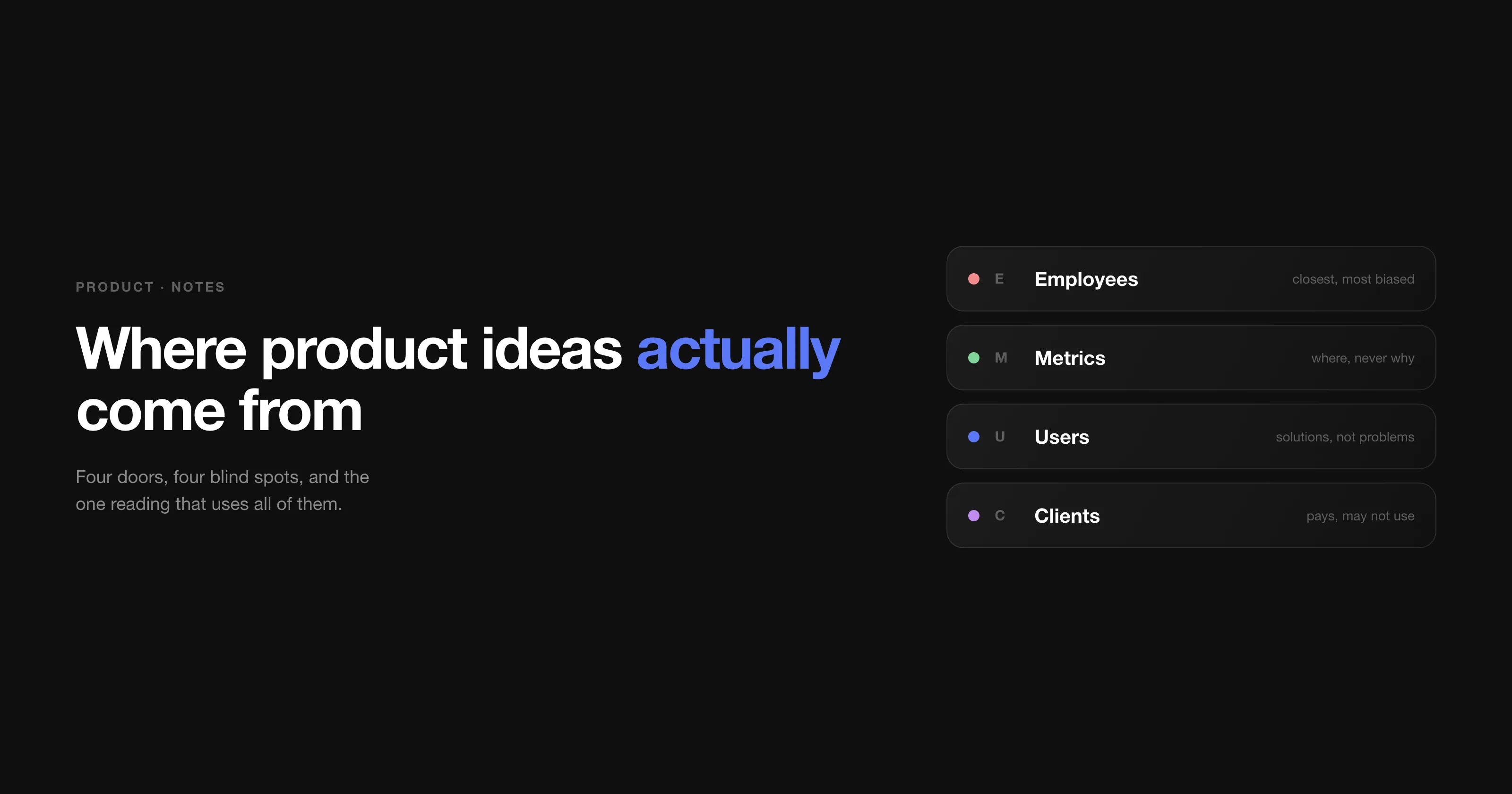
There is a note in my files from 2021 that is four bullet points long. It says that product ideas come from four places — Employees, Metrics, Users, Clients — and then it stops, because at the time that was all I needed to remember.
Five years of shipping later, the four letters have earned their keep, but not for the reason I wrote them down. They are not a list of where to go looking. They are a list of who is lying to you, and in which direction.
The four doors
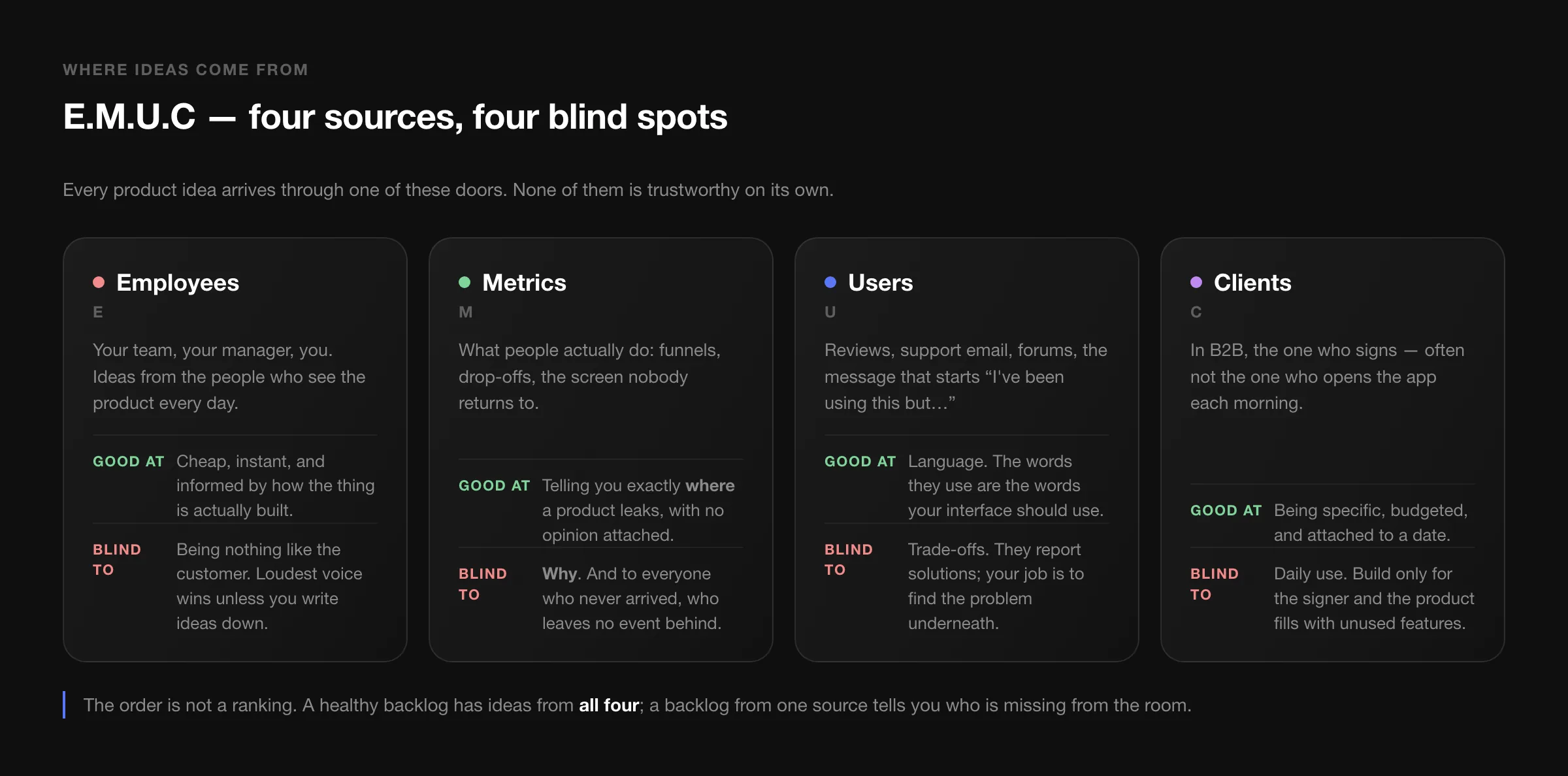
E — Employees
Your colleagues, your manager, and you. This is the cheapest channel and the one every team already has: ideas arrive in standups, in hallway conversations, in the message that starts "wouldn't it be cool if".
Two things go wrong with it. The first is that nobody on the team is a user. You know where every feature lives, you have never seen the empty state, and you stopped reading your own onboarding copy months ago. The second is social: without somewhere to write ideas down, the ones that survive are the ones said loudest, or said by the most senior person in the room. A plain list that anyone can add to — with a name and a date next to each line — fixes most of that, because it turns a debate into a backlog.
M — Metrics
What people actually do, as opposed to what they say they do. Funnels, retention curves, the screen that gets opened once and never again.
Metrics are the only source in this list with no opinion, and that makes them the easiest to trust and the easiest to misread. They are excellent at where: 38% of new accounts stop on this screen. They say nothing about why, and inventing the why while looking at a chart is the most common way a team ends up building the wrong thing confidently.
They also have a blind spot shaped like everyone who never arrived. People who bounced off your pricing page, who could not find you at all, who downloaded the app and deleted it before the first event fired — none of them exist in your dashboard. The quietest number in any product is the one that was never measured.
U — Users
Reviews, support email, forum threads, the Reddit comment that starts "I've been using this but". This is where the words come from. Not the roadmap — the words. If customers call the thing a "wallet" and your interface calls it an "account", the interface is wrong, and only this channel will tell you.
The classic failure is to treat user requests as a specification. People report solutions, because describing a problem is harder than naming a fix. "Add an export button" is a solution; the problem underneath might be that they do not trust your app to keep their data, and an export button is how they would feel safer. Ship the button and you have solved it. Miss the sentence underneath and you will ship four more buttons before you notice the pattern.
C — Clients
In B2B, the person who signs the contract is often not the person who opens the product on a Tuesday morning. My note flagged this in half a line and it deserves more.
Clients are wonderfully concrete — they have a budget, a date, and a list. They are also describing a product they will not use. Build only for the signer and you get a product that demos beautifully and sits unopened: compliance reports nobody reads, dashboards nobody opens, an admin panel with forty settings because asking for settings is how a buyer expresses uncertainty.
The fix is boring and works: before committing to anything a client asks for, talk to one person who will have to use it daily. Ten minutes is enough to find out whether the request is a need or a guess.
The point is reading all four at once
Any single door gives you a distorted picture. The reason to keep all four open is that a real problem shows up at every one of them, in a different accent.
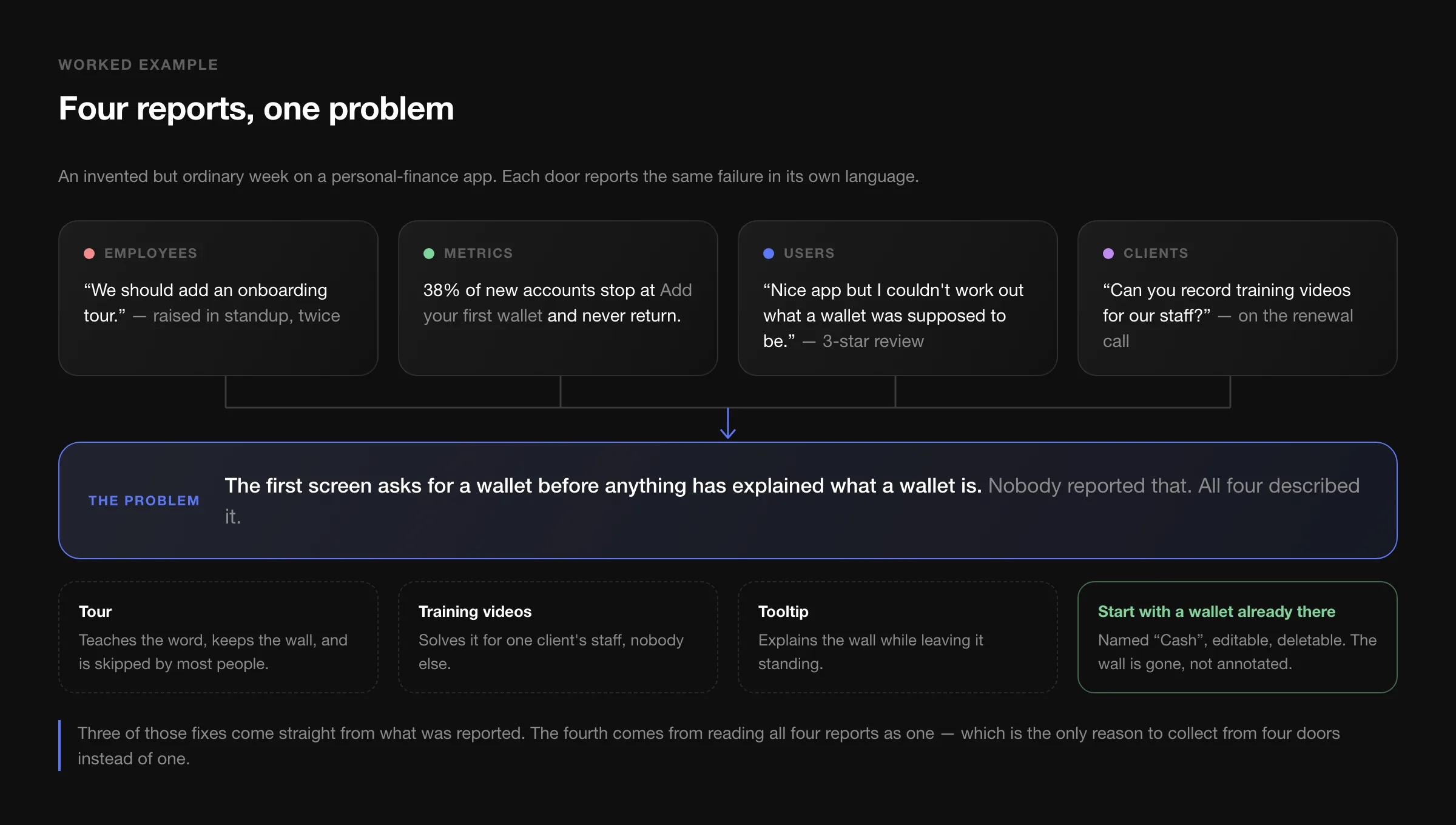
In the example above, four inputs arrive in the same week: the team wants an onboarding tour, the funnel shows people stopping at "add your first wallet", a three-star review says the reviewer could not work out what a wallet was, and a client asks for training videos.
Taken one at a time, each produces a sensible, wrong answer. A tour teaches the vocabulary and leaves the wall standing. Training videos solve it for one client's staff. A tooltip annotates the wall. Read together, they describe something simpler: the first screen asks for a wallet before anything has explained what a wallet is — so the product should open with a wallet already there, named "Cash", which the user can rename or delete.
Nobody requested that. It is what all four were describing.
Running the four channels without a department
You do not need a research function for this. You need four habits that take about an hour a week between them.
| Source | The habit | How often |
|---|---|---|
| Employees | One shared list anyone can add to, with a name and a date. No triage at the point of capture. | Continuous; review fortnightly |
| Metrics | One funnel for the first session, one for the core action. Look at the steps, not the totals. | Weekly |
| Users | Read every one- and three-star review, and every support email, yourself. Paste the sentences, not your summary of them. | Weekly |
| Clients | Before building a request, ten minutes with one person who will use it daily. | Per request |
Two details matter more than the cadence. Capture quotes, not paraphrases — your summary of a complaint has already begun solving it, and the original wording is the part you will need later. And keep the source attached to the idea, because "the CEO suggested it" and "nine users said it" belong in different columns when the backlog gets long.
Having ideas is the easy part
A healthy backlog contains ideas from all four doors. A backlog from one door tells you who is missing from the room: all-employee means nobody is talking to customers; all-client means the roadmap has been outsourced to whoever shouted last.
But collecting is not deciding. Once the list exists, the triage I wrote about in the market analysis notes still applies — a candidate has to win you more users, make current users happier, or strengthen the brand. E.M.U.C fills the list. It does not rank it, and it was never meant to.