
Market analysis you can finish in an afternoon
Sizing a market from both ends, the four kinds of competitor and which one actually beats you, and the five things worth scoring — written out from a page of notes I have been using since 2021.
I keep a page of notes from 2021 called Market Analysis. It is mostly bullet points, written while I was running product at an agency and had to answer the same two questions for every new idea that walked in: how big is the room, and who else is already standing in it.
The notes have aged better than I expected, so here they are properly written out, with the arithmetic filled in and one tool quietly replaced because it no longer exists.
How big is the room
There are two directions to count a market from, and they disagree on purpose.
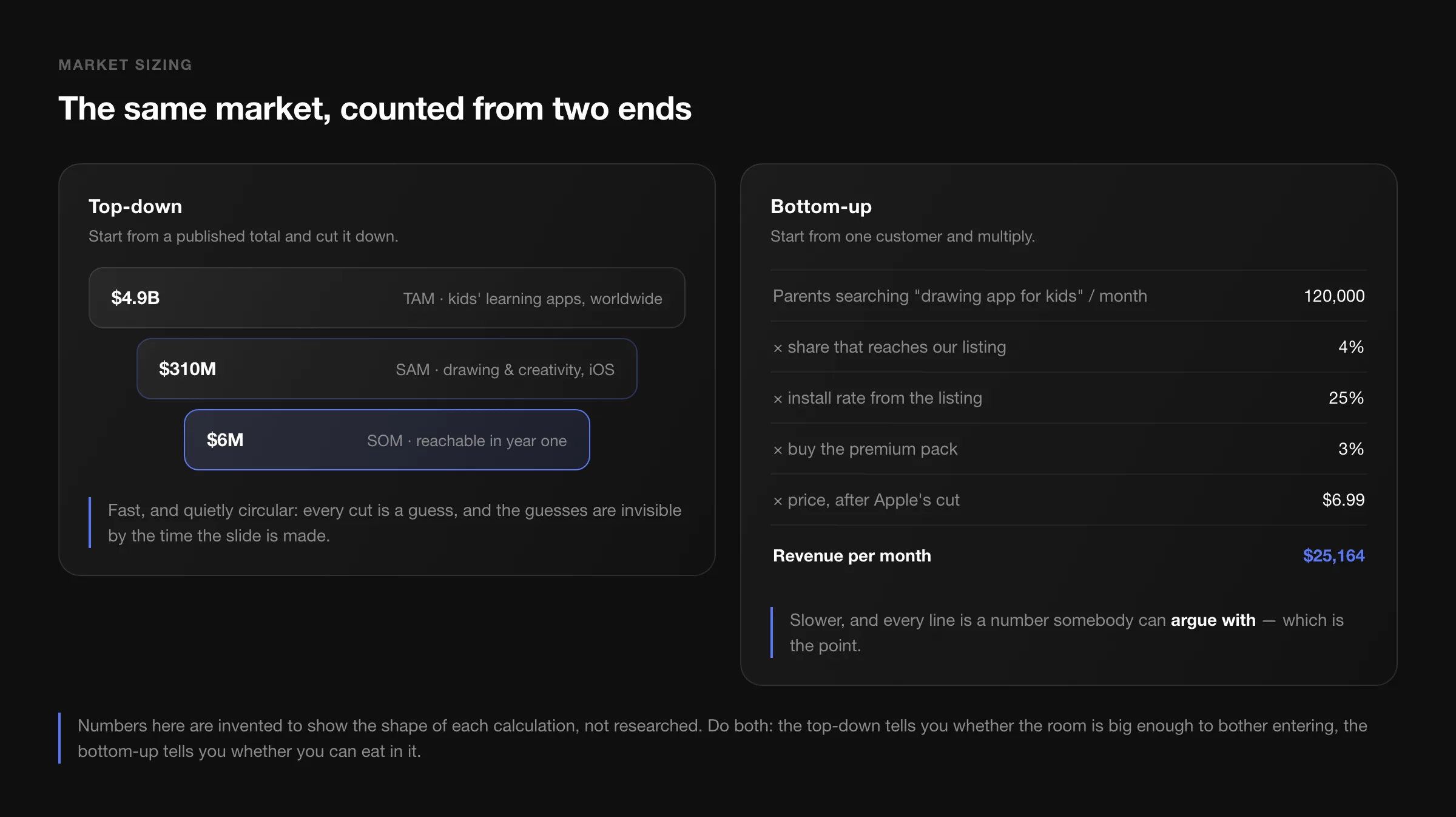
Top-down starts from somebody else's total. You find a report that says kids' learning apps are a $4.9B market, decide your slice is the drawing-and-creativity corner on iOS, decide you could reach a few per cent of that in year one, and write down the result. It takes ten minutes. Every one of those cuts is a guess, and by the time the number reaches a slide the guesses are invisible.
Bottom-up starts from one customer and multiplies. How many people look for this in a month, how many of them see us, how many install, how many pay, at what price. It is slower, and the number is usually smaller and more depressing — but every line is something a colleague can argue with. That is the entire value. A number nobody can argue with is a number nobody has checked.
Do both. The top-down tells you whether the room is big enough to be worth entering. The bottom-up tells you whether you can eat in it. When they disagree by 100×, the bottom-up is usually right and the top-down is measuring a room you cannot actually get into.
One correction to my own notes: they say to track competitor traffic with Alexa. Amazon shut Alexa.com down in May 2022. What I use now:
| Question | Where I look |
|---|---|
| How much web traffic do they get? | Similarweb, Semrush |
| What do people search for, and how often? | Google Keyword Planner, Ahrefs |
| How big is a mobile competitor? | Sensor Tower, Appfigures, and the review count on their store listing |
| Who gave them money, and who did they buy? | Crunchbase |
Review counts are the most under-rated of these. They are public, they are not marketing, and the ratio between installs and reviews is stable enough within a category that a competitor's review count tells you roughly what order of magnitude you are dealing with.
Who else is in the room
My notes open the competitor section with a decision tree that I still think is the most useful thing on the page:
Do you have competitors?
Yes → good, write down who they are.
No → are you a genius? Yes → congratulations, you are Steve Jobs. No → there is no customer demand.
It is a joke with a real edge. "We have no competitors" almost never means the market is unclaimed. It means either you have not looked properly, or nobody wants this. The third possibility — that you are genuinely first — is real but rare, and the people it happens to can usually name the five companies that tried before them and explain why those failed.
Four kinds, and they are not equally dangerous
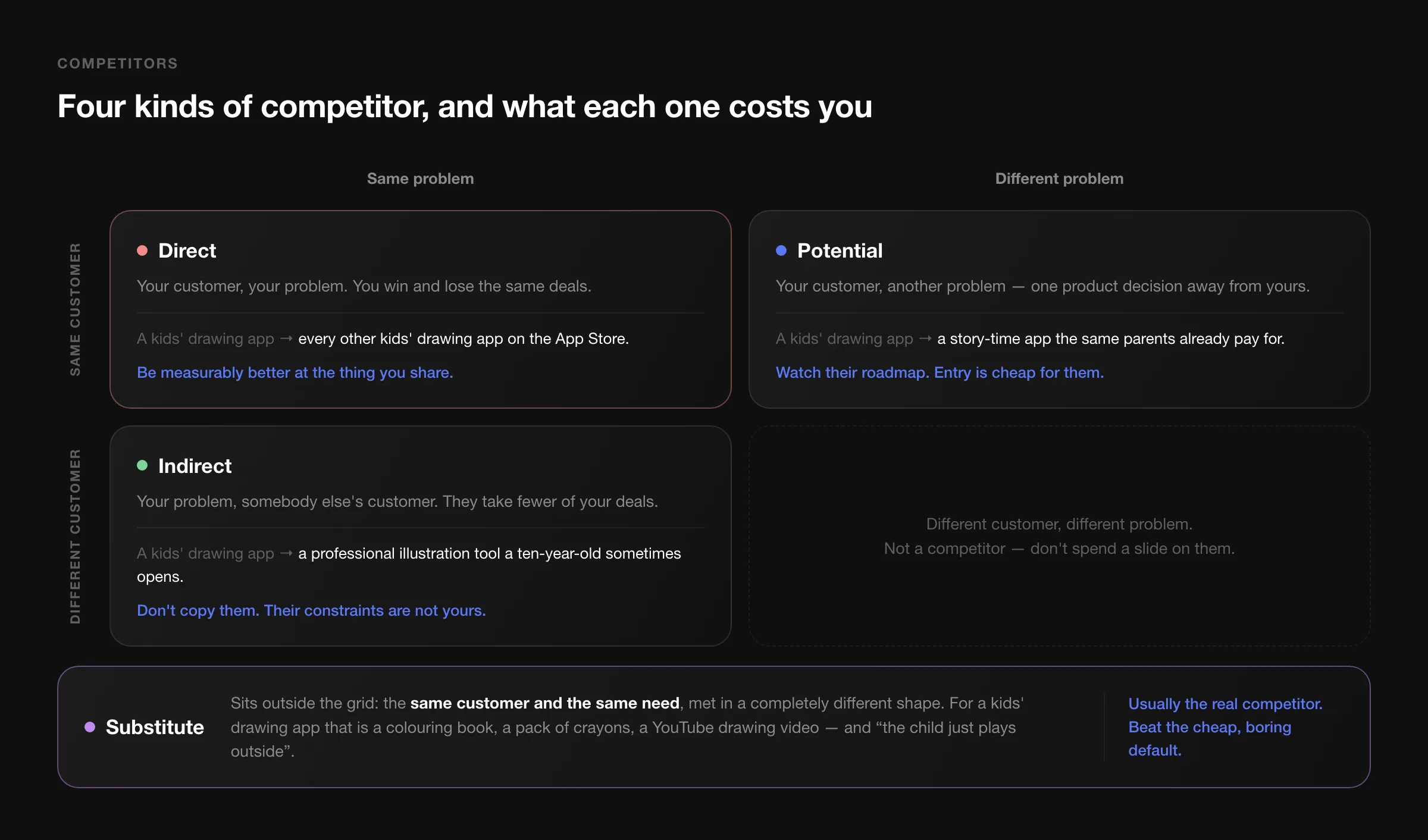
Direct competitors share your customer and your problem. They are the easiest to find and the ones everybody over-indexes on, because comparing feature lists feels like work.
Indirect competitors solve your problem for somebody else. A professional illustration tool is not after the parents buying a kids' drawing app, even though a ten-year-old can open one. Watch them, learn from them, do not copy their roadmap — their constraints are not yours.
Potential competitors have your customer already and solve something else for them. These are the dangerous ones, because for them entering your market is a feature, not a company. If a story-time app with ten million parents decides drawing is next, they start with distribution you will never buy.
Substitutes do not fit the grid, and that is the point. Same customer, same underlying need, completely different shape: a colouring book, a pack of crayons, a YouTube video, or the child simply going outside. Substitutes are what you actually lose to. They are cheaper than you, they already exist in the house, and nobody has to install them.
When a launch underperforms, the post-mortem usually names a direct competitor. In my experience it was the substitute.
Finding them without a research budget
First, decide where the answers will live — a Notion page, a spreadsheet, anything you will still open in three months. Research you cannot find again is entertainment.
Then, in rough order of how much signal they give per hour spent:
- Search like a customer, not like a founder. Customers do not search your category name; they describe the problem. Type the long, clumsy sentence a parent would type — "app to teach my 5 year old to draw" — and see who has paid to be there.
- Use the operators.
site:reddit.complus your problem description finds conversations rather than landing pages. Quotation marks pin an exact phrase.-brandnamedrops the market leader so you can see who is underneath. - Read one-star and three-star reviews of the leaders. Five-star reviews tell you nothing. Three-star reviews are written by people who want the product to work and are telling you exactly where it does not — which is the cheapest feature research available.
- Read the forums. Reddit and Quora, plus whatever niche forum your customers actually use. You are looking for the sentence "I've been using X but..." — everything after the "but" is a brief.
- Look at job ads. A competitor hiring three iOS engineers and a billing specialist has told you their roadmap for the next two quarters without meaning to.
Five things worth scoring
Once you have a list, the temptation is to build a feature matrix with forty rows. Don't. My notes list five criteria, and I have never needed a sixth.
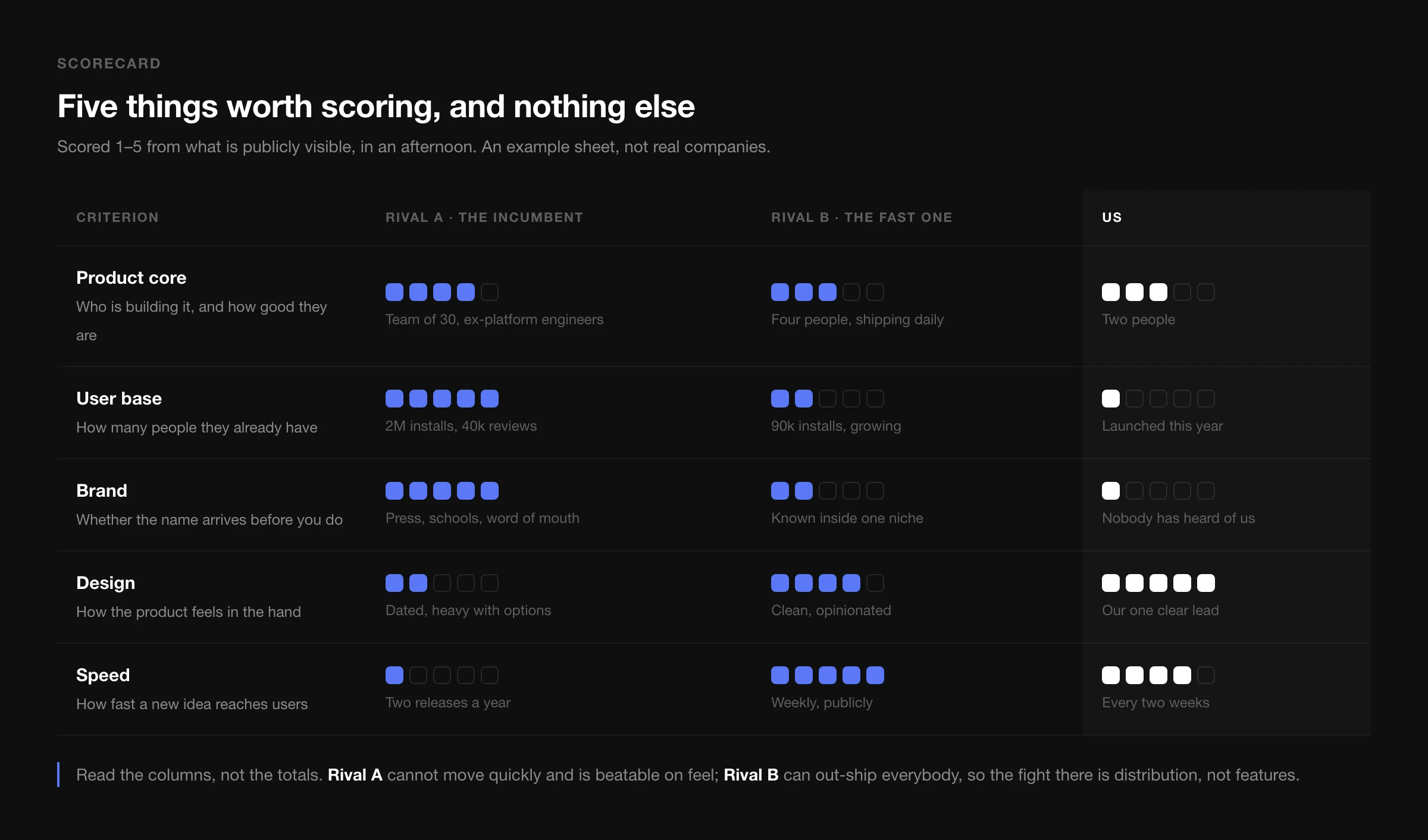
- Product core — who is building it. Team size and background, visible from their site and LinkedIn.
- User base — how many people they already have. The number you have to take away from, or route around.
- Brand — whether their name arrives in the room before yours does.
- Design — how the product feels in the hand. Still the most common weak point of an incumbent.
- Speed — how fast an idea of theirs reaches users. Check their changelog and release notes, not their blog.
Score each one to five and resist adding up the columns. The total is meaningless; the shape is the insight. A rival who scores 5 on user base and 1 on speed is beatable, and you beat them by shipping, not by out-marketing them. A rival who scores 5 on speed and 2 on brand will out-build you, so you compete on distribution instead.
Keeping it current
A market analysis is a photograph, and it starts ageing the moment you take it. Three things are worth a standing alert rather than an annual refresh:
- Funding. A round tells you what they are about to be able to afford. Crunchbase.
- Acquisitions. What a competitor buys is what they could not build — and it dates their roadmap precisely.
- What they ship. Google Alerts on the product name, their changelog, their App Store release notes. Release notes are the most honest document a company publishes, because nobody in marketing reads them.
Then do something with it
The reason to do any of this is to decide what to build next, and the notes end with a triage I still use. A candidate feature has to do at least one of three things:
- get you more users,
- make your current users happier,
- or strengthen the brand.
If it does none of them, it is not a feature, it is a hobby. Market analysis is not there to produce a document. It is there so that when somebody asks why you are building this and not that, the answer is a sentence about a real customer and a real alternative — not a number copied off a slide.